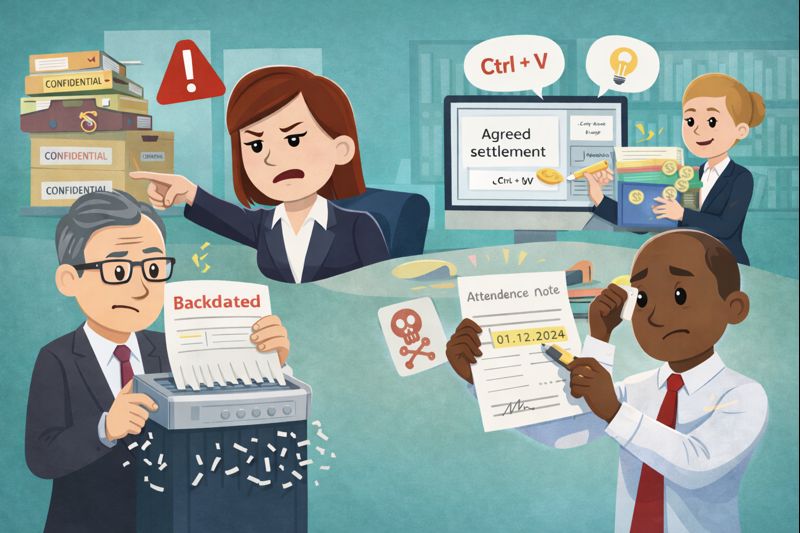



We all like to think that the red lines are obvious.
You don’t fake a signature. You don’t “tidy up” an attendance note after the event and pretend it was written at the time. You don’t mislead the court. You don’t play fast and loose with the truth to cover up a mistake.
Everyone knows that. Don’t they?
And yet, if you spend any time reading disciplinary decisions, you keep coming across the same uncomfortable pattern: very serious outcomes that start with something small, rushed, or “obvious”. Not always planned dishonesty. Often a moment of poor judgement, under pressure.
That’s what makes it so unsettling. Because it’s not hard to imagine how it happens.
Pressure makes people do odd things
A lot of the really painful scenarios happen in the same conditions: too much work, too little time, and someone breathing down your neck for an answer.
A client is panicking. A deal is wobbling. A partner wants it done before lunch. The other side is being aggressive. You’re trying to keep everyone happy, and the “right” option feels like it will cause a bigger problem than the “easy” option.
That’s when the internal monologue starts.
“They definitely would have signed it.”
“It’s just an admin thing.”
“I’ll fix it properly later.”
“No-one is going to notice, let alone care about this.”
“Everyone does it.”
The trouble is that those thoughts can feel completely normal in the moment, especially if you’re tired and you don’t want to be the person who creates delay.
But the SRA isn’t interested in the internal monologue. It’s interested in what you actually did.
We sometimes talk about integrity as if it’s a personality trait. “They’re a good person, they’d never do anything dishonest.” In regulatory terms, that isn’t how it works.
The core principles of professional practice are not a set of values you aspire to when you have time. They’re standards that apply on the day the pressure is highest, when the client is angry, when the court deadline is looming, and when the easiest option is the one you know you shouldn’t take.
And the point that catches people out is that dishonesty doesn’t always look like dishonesty to the person doing it. It often looks like problem-solving.
The myth of “everyone knows”
There’s a particular kind of risk that comes from unspoken rules. Most firms assume their lawyers know what they can’t do. They’ve been to law school. They’re intelligent. They’ve been training for years. Surely no-one needs to be told that you can’t copy and paste a signature, or rewrite an attendance note, or fudge a detail in a witness statement.
But “surely” is doing a lot of work there.
People arrive from different backgrounds and different cultures. Some have worked in environments where questionable shortcuts were normal. Some are newly qualified and terrified of looking incompetent. Some are experienced but stretched, and start seeing small compromises as harmless because they’ve got away with them before.
And some people, very simply, have never been told clearly and directly where the line is.
Compliance by osmosis doesn’t work
A lot of professional conduct training happens by osmosis. You watch how others behave. You learn what gets challenged and what gets waved through. You pick up what the partners care about and what they don’t.
That’s fine when the culture is healthy and the basics are reinforced.
It’s dangerous when the culture is rushed, vague, or overly focused on output. Because silence can sound like approval. If nobody ever says “absolutely not”, people will start to assume there’s more flexibility than there is.
And once one person crosses a line and doesn’t get called out, you’ve got a new “normal”.
This is why “everyone knows you can’t do that” isn’t a safe assumption. It’s the kind of assumption that shows up, years later, in an SDT judgment.
So what should we do differently?
This isn’t about treating solicitors like children. It’s about acknowledging something simple: good people make bad decisions when they’re stressed, and ambiguity makes that worse.
The firms that stay safest tend to do a few things consistently:
- They spell out the non-negotiables, plainly and repeatedly.
- They give examples. Real scenarios. The kind people actually face.
- They make it easy to ask “Can I do this?” without fear of being judged.
- They reward people for putting the brakes on when something feels off, even if it creates delay.
- And when someone makes a mistake, they deal with it early, honestly and openly. Because problems are usually fixable at the beginning. They become career-ending when someone tries to cover them up.
The real risk isn’t that solicitors don’t know right from wrong. The real risk is that we assume the red lines are so obvious that we don’t bother drawing them.
And then one day, under pressure, someone steps over a line they didn’t realise was quite so close.