


Happy New Year – and welcome to the first COLP Insider of 2026.
If you’re reading this with a January inbox that already feels like it’s been through a spin cycle, you’re not alone. The regulatory world hasn’t eased us in gently: includes a MoJ consultation that looks very much like a stealth tax on client money, a surprisingly unified backlash to the FCA AML supervision proposal, and the LSB pushing “professional ethics” from a worthy concept into something more organised and measurable.
On our side, 2026 is shaping up to be a big year. The eagle-eyed among you may have spotted a subtle shift: we’re transitioning our brand from Jonathon Bray to JBL Compliance. Same people, same approach, same obsession with making compliance practical and useful – just a refreshed identity that better reflects who we are as a team. You’ll see the change roll out over the next few weeks.
We’ve also got a lot coming down the track: a new website that’s almost ready, and a pipeline of on-demand training materials we’ve been building for months (more on that soon). For now, make a brew, dip into the sections that matter most to you, and if there’s a question you’d like us to tackle in Compliance Corner, just reply and send it over.
Jon and the team.
What your “SAR sign” tells you about why you don’t submit Suspicious Activity Reports – and how to change your behaviour

Sophie has written a brilliant little reset for MLROs: if your firm “never has SARs”, the odds are you’ve got some hiding in plain sight.
In What your SAR sign tells you…, Sophie borrows the 90s magazine “personality quiz” format to unpack the real reasons SARs don’t get submitted (overthinking suspicion, portal procrastination, board pressure, privilege myths, DAML dithering) and gives practical, behaviour-based fixes you can apply straight away.
COFAs are in the spotlight in 2026

COFAs are going to feel like main characters this year.
In this short post we set out why: the regulator’s focus on client money is hardening, expectations around oversight and evidence are rising, and “signing the reconciliation” is no longer something you can treat as a routine monthly admin task.
If you’re a COFA (or you support one), this is your early warning and your opportunity to concentrate on financial controls in 2026.
A COLP’s hardest conversation

Every COLP has one conversation they dread.
A partner says: “We’ve always done it this way.” The room moves on. And that’s how small shortcuts become culture.
In this post we share some simple ways to challenge risky decisions without turning yourself into the “Department of No” – how to keep it calm, keep it commercial, and leave behind an audit trail you’ll be grateful for later.
News and Guidance
Client account interest: MoJ consultation proposes raid on solicitors’ client accounts
Just when you thought it was safe to go back into the water, following the SRA’s temporary reprieve on client money last month, along comes the MoJ with an even more audacious proposal. The government wants to fund legal aid by taking interest earned on firms’ client accounts.
The new consultation is for an “Interest on Lawyers’ Client Accounts Scheme” (ILCA) and it opened on 7 January 2026, closing on 9 February 2026. The stated aim is to raise funds from interest on client money and direct it to areas of “greatest need” within the justice system.
The proposed mechanics are that, for pooled client accounts, firms would remit 75% of the interest generated to the scheme (and it asks whether that should be higher, up to 100%). For designated client accounts, it proposes 50%. It is also actively asking whether third party managed accounts (TPMAs) should be brought into scope too.
If you are thinking “but we have rules about paying clients a fair sum of interest”, you are right. The consultation expressly acknowledges the SRA’s rules. The MoJ’s proposal sits on top of that i.e. take a slice for the government first, then leave the remainder to be dealt with under the existing regulatory arrangements.
Let’s be clear about what this is: a stealth tax on legal services. It would undoubtedly put inflationary pressure on fees.
So what should COLPs and COFAs do with this now?
First, don’t ignore it on the basis that “it won’t happen”. The consultation document is detailed, it compares England and Wales with IOLTA-style schemes overseas, and it leans on commissioned research suggesting most firms are not “reliant” on client account interest. That’s a clear sign the MoJ thinks this is actionable.
Second, think about the mechanics of calculating and paying interest. Some firms rarely pay interest to clients because of the “de minimis” threshold in their policy. What challenges would it create to have to calculate interest on every pound of client money held by your firm?
Third, sanity-check your own position. Do you (a) routinely account to clients for interest; (b) return it above a threshold; (c) use some of it to offset banking and cashiering costs; or (d) quietly rely on it as a buffer? The consultation is written as if the sector largely shrugs at losing the interest. Some firms will read that and think: “that may be true overall, but it’s not true for us.”
Finally, if you have views, respond. This isn’t just a “big firm conveyancing” issue. Probate, estate administration, corporate and any practice area with material balances held for more than a few days could be affected.
FCA AML takeover is a bad idea: SDT and others unify to warn about the risks
You know a proposal is in trouble when you struggle to find anyone in the legal ecosystem prepared to say “yes, this is a good idea”.
HM Treasury’s consultation on moving AML supervision of the legal sector (and other professional services) to the FCA closed on 24 December 2025. The theory is that a single supervisor will result in more consistency.
The overwhelming tone of the responses from the legal world is the opposite: this looks like a structural change that creates new risks, new cost and a long period of confusion, without a clear case that it will improve outcomes.
What’s striking is how aligned the concerns are, even across bodies that don’t always sing from the same hymn sheet.
The Law Society strongly opposes the reforms and warns the changes would increase fragmentation rather than simplify oversight.
The Solicitors Disciplinary Tribunal, from a different angle, raises “double jeopardy” style issues and practical case-handling concerns.
The Bar Council says that the proposal is a blunt rewire of AML supervision that risks creating duplication and misfit regulation if the FCA model is simply imported into the legal context.
CILEX Regulation’s response reads warns that the transfer needs very careful design to avoid duplication, uncertainty and unintended consequences for consumer protection and market integrity.
Even the LSB, which is usually looking at the system-level picture, focuses on the need for clarity about how enforcement will work in practice across AML and legal services regulation, and what the legal sector will experience as a result of the FCA taking over. That is not the language of confidence.
When you boil all of that down, there are shared concerns about regulatory overlap and having “two masters”. AML supervision moving to the FCA will not remove the SRA’s broader role. The professions are worried about duplicated information requests, parallel investigations, and inconsistent expectations.
Second, loss of legal-sector nuance. AML supervision in legal services is inseparable from confidentiality, privilege, conflicts, and how legal work is conducted and supervised. The FCA is an experienced regulator, but it is not a legal services regulator.
Third, transition risk. Even if you believe a single supervisor is the end goal, the move itself is a major operational change for firms and regulators. The consultation responses anticipate a messy handover where nobody is quite sure who owns what for a while.
The saving grace is that the Treasury does not expect any of this to happen for some time yet – on one recent round table event they were talking about years to get all the legislative ducks in a row. So for now, firms just have to keep on doing their best to comply with the Money Laundering Regulations. And there’s always a chance of a government U-Turn…
Professional Ethics Network: the oversight regulator wants a “cultural step change” – and a new forum to drive it
You can tell the LSB has decided professional ethics is now a flagship theme, because it is starting to build infrastructure around it.
The Legal Services Board is developing a Professional Ethics Network (PEN), intended to act as a cross-sector vehicle for embedding the principles that will sit behind its forthcoming policy statement.
On the LSB’s own description, the PEN is more than a talking shop. The draft 2026/27 business plan describes it as a way to “embed the principles” in the policy statement, identify emerging ethical challenges, and develop and share recommendations about how professional ethics is understood and applied across the sector.
So what does this mean in practice? Expect “culture” and “ethics” to become more operationalised. Whenever the oversight regulator starts talking about measurable change and implementation vehicles, it usually translates into more concrete expectations for the SRA and firms.
Compliance corner: Can we use AI virtual assistants?
Q: We’re thinking about using an AI “virtual assistant” on our website and in email to (1) answer basic legal questions from prospective and existing clients, and (2) chase clients for outstanding information. Are we allowed to do this under the SRA rules?
A: Yes, you can use an AI assistant – but you need to be really clear what it is (and is not) doing.
The SRA’s starting point is technology-neutral: you can use whatever tools you like, but the Principles and Codes still apply. The fact it’s “AI” doesn’t dilute your usual duties.
In practical terms, there are two very different use cases in your question.
- Chasing clients for missing information (generally low risk, if done properly)
Using AI to send polite chasers, explain what’s outstanding, and route replies back into your case management process. The main risks are data protection/confidentiality, client relationship management, and the assistant accidentally asking for something it shouldn’t.
You should keep it “admin-only” by design and minimise data. Don’t give the tool any more personal or matter information than it needs, and avoid pasting client communications into public tools.
Put a human in the loop for exceptions: if a client says “I can’t provide that” / “this is sensitive” / “I want advice”, it should stop and escalate to a person. And make sure you can evidence oversight: logs of what was sent, when, and what the client provided (and who checked it).
- Answering “basic legal questions” (higher risk than it sounds)
This is where firms can get into trouble, because “basic legal questions” from a client are often really “legal advice in disguise”.
Two specific risks to keep front of mind:
- Hallucinations and confident wrong answers. Generative AI can produce plausible-sounding responses that are inaccurate or incomplete, so you cannot treat it as a reliable legal adviser without robust checking and supervision. Think of it as a capable paralegal, rather than a solicitor replacement.
- Confidentiality and privilege. If client facts are fed into a tool that reuses data for training, stores prompts in a way you can’t control, or is accessible to others, you are into immediate confidentiality and security territory. The SRA flags confidentiality and legal privilege as central risk areas when firms adopt AI.
So, if you do want an AI assistant answering questions, my rule of thumb is:
- Keep it general and signposting: “here’s how the process works”, “here are common documents we need”, “here are typical timescales”, “here’s when you need independent advice”.
- Avoid anything fact-specific: do not let it apply law to someone’s particular circumstances, predict outcomes, advise on merits, or draft anything that could be relied on without human review.
- Make the boundaries obvious: a clear disclaimer (“information only, not legal advice”), and an easy route to speak to a human.
- Decide (and document) when you will tell clients you use AI. If it’s client-facing and interacting with them in place of a person, you should assume transparency will be expected.
Before you switch it on, you should have in place:
- An internal AI policy and permitted-use list (who can use what tool, for what, and what must never be entered).
- Data protection by design: confirm your lawful basis, whether the supplier is a processor/controller, and complete a Data Protection Impact Assessment where personal data is in scope (most client-facing deployments will trigger one).
- Supplier due diligence and contracts: where is data stored, is it used for training, what security controls exist, what retention applies, and can you audit?
- Testing and supervision: run it in parallel, stress-test edge cases, sample outputs, and treat it like any other delegated work product that requires supervision.
This is not legal advice. If you have a question you would like us to answer in this section, feel free to send it to info@jonathonbray.com
Free CPD
Next session: Signing with confidence – mastering client account reconciliations for COFAs
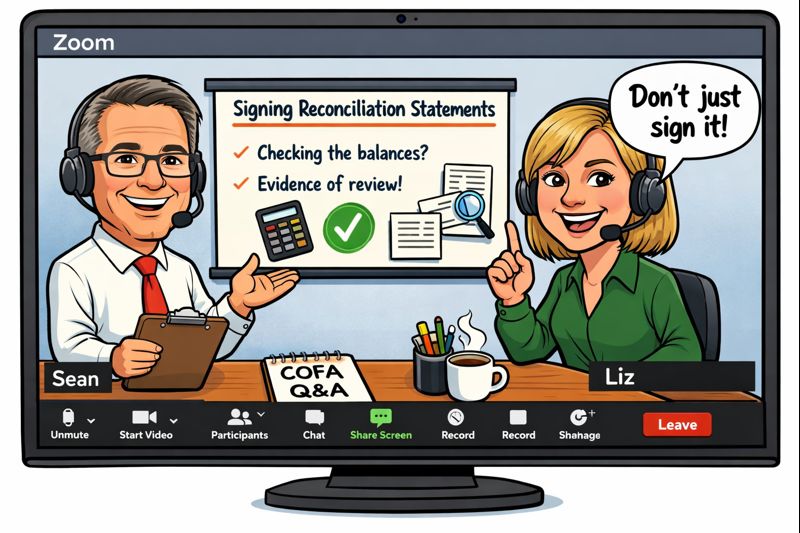
We kick off 2026 with our first webinar specifically for COFAs, focusing on one of the most critical controls in the SRA Accounts Rules.
Are you signing off your client account reconciliations with total confidence? It’s a COFA’s job to sign off on reconciliations, but knowing what to look for is where the challenge lies.
We’ll be asking the tough questions:
- Is there a breach?
- What are the systems telling us?
- What is being missed?
What we’ll cover: The mechanics of a perfect reconciliation. Common “horrors” and red flags to watch out for.
Expert insights from two former SRA Forensic Investigators: Sean Hankin and Liz Bond will be taking the lead on this not-to-be-missed session. So whether you’re a veteran COFA or new to the role, join us to ensure your firm’s “engine room” is running exactly as it should.
When: 12:00pm on Wednesday 21st January 2026 (1 hour).
Where: Zoom (register here – limited spaces)
Prefer in-person? We are planning a serious of COFA Masterclasses across the country in 2026, contact us for more information. We also run small group finance sessions at your office.
Disciplinary Watch
AML financial penalties
Newman Law LLP – £8,885 (CDD, source of funds, client/matter risk assessments, and failing to follow its own AML arrangements)
Trueman’s Solicitors Limited – £21,764 (policy, CDD, source of funds, client/matter risk assessments)
CD&R Galaxy UK Opco Limited – £33,438 (no firm-wide risk assessment, and client/matter risk assessments)
Sylvester Amiel Lewin & Horne LLP – £17,302 (firm-wide risk assessment and file-level risk assessments)
TM Fortis Solicitors Limited – £12,926 (non-compliant FWRA, AML policy and CMRAs)
Regler & Company (Chinnor) Limited – £9,500 (PCPs, risk assessments and source of funds)
Haighs Solicitors – £6,236 (FWRA, AML policy and file-level risk assessments)
Vincent Yee Solicitors Ltd – £6,804 (AML policy, FWRA and CMRAs)
Fonseca Solicitors Ltd – £4,979 (failing to conduct client/matter risk assessments over an extended period)
Watermans – £4,584 (policy and client/matter risk assessments)
Nigel Pullen Solicitors Limited – £4,430 (record-keeping: not keeping records of risk assessments)
AWD Legal Services Limited – £3,287 (firm-wide risk assessment)
Whiteheads Solicitors (Staffordshire) Ltd – £2,584 (CMRAs and source of funds scrutiny)
Conduct and disciplinary outcomes
Samina Ahmed – struck off for dishonest time recording (an average of 28 billable hours per day).
Jack Alexander Williams – two-year suspension for dishonest conduct involving deletion of parts of a handover memo before sending it to his supervisor. A rare reprieve from strikes off.
Dylan Patel (non-lawyer compliance officer) – section 43 order (strike off) after dishonestly telling his firm he was in the office when he was working from home
Jessica Sayer (paralegal) – section 99 disqualification following misleading updates to clients about probate case progress.
Peter Brodie (Probate and Trust Manager) – section 99 disqualification following criminal convictions, including sexual offences.
Wesley Bower and Steven Westwood (non-solicitor directors) – section 99 disqualification for SSB directors with findings including dishonesty and lack of integrity (director-level responsibility for systemic failures).
Support for COFAs and finance teams

We’re ramping up our support for COFAs and legal finance teams – with some serious firepower. Sean Hankin (almost 30 years regulatory experience and co-author of the current SRA Accounts Rules) and Liz Bond are now delivering bespoke masterclasses for COFAs and accounts staff, focused on what the regulator really expects in 2025.
Alongside the training, we’re offering client account health-checks to stress-test your systems before the SRA (or your reporting accountant) does, and targeted projects to clear stubborn residual balances in a way that keeps both the regulator and clients happy. If your client account keeps you awake at night – or you’d like to make sure it doesn’t – we’d be very happy to talk.
Independent AML audits

What we do – contact us for further information about our services
- Outsourced COLP and COFA support
- COLP and COFA coaching
- Compliance audits
- NEW: Client account health checks
- NEW: Residual balance projects
- New firm and ABS applications
- Independent AML audits (Regulation 21)
- Training (online, remote, on demand)
- AML and GDPR workshops
- PII reviews
- Remote file reviews
- TPMAs
- Escrow accounts
- AML and sanctions searches
Older posts
Beyond the balance sheet: Staff money worries are your firm’s risk
We tend to think of “financial risk” as something that lives in client account – but what about the money worries your own staff are carrying around with them? In this article, Sophie looks at new research on financial well-being in the profession, and argues that personal financial stress can drive over-billing, overwork and poor decision-making, with real consequences for quality, ethics and the firm’s bottom line. If you care about culture, competence and reputation, you may need to start treating staff finances as a live compliance issue.
Amelia’s next challenge: Our latest compliance webinar write-up
What should a brand new COLP/COFA focus on in their first year, especially when they’re already wearing the MLRO hat?
In our latest Harbour Gate webinar, we dropped in on fictional MLRO-turned-COLP Amelia Price as she gets to grips with complaints, client money, AI tools and the SRA’s shifting priorities. It’s a practical, story-led debrief from this week’s live webinar.
How to be an ACSP: a guide for law firms
Thinking about becoming an Authorised Corporate Service Provider, or wondering whether you really need to? Our new guide walks law firms through the Companies House reforms, what ACSP status actually involves, and how to build a compliant, joined-up process alongside your existing AML framework. If you intend to verify clients’ identity or file at Companies House, this is one to read as the new regime comes into play.