


Hello, and welcome back to COLP Insider.
This edition has a distinct client money flavour. The Ministry of Justice has launched a consultation on interest earned on client account, with proposals that could fundamentally change how the profession handles client interest. Sophie’s call to arms sets out what’s being proposed and, more importantly, asks for your real-world examples so we can feed them into our consultation response.
We’ve also published a write-up of our COFA webinar on client account reconciliations – the three-way check, the paperwork trail, and the difference between a timing issue and a real shortfall – plus a more reflective piece from Sam on why “everyone knows you can’t do that” is not a safe assumption when pressure and shortcuts creep in. Alongside that, there are key consultation deadlines, updates on sanctions and complaints handling, and a packed Disciplinary Watch.
As ever, if there’s a risk and compliance scenario you want us to cover in Compliance Corner, just reply and send it over.
Jon and the team.
Call to arms: Interest on client account – the controversial proposals from the Ministry of Justice
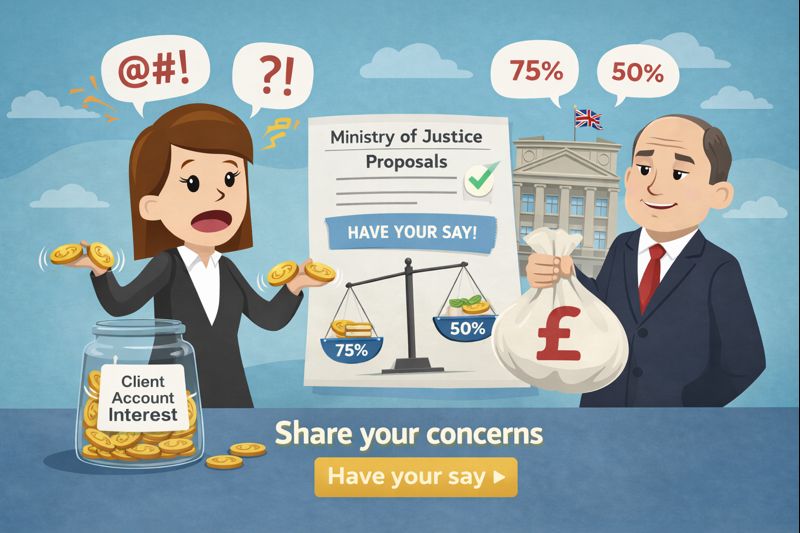
We are preparing a response to the Ministry of Justice proposals that could see a significant proportion of interest earned on client account diverted to government. Our response will be informed by your feedback via a short survey.
In this post, Sophie sets out the proposals and asks for your real-world concerns, observations and any alternative suggestions you may have. This is a fundamental issue: it goes directly to our relationship with clients, access to justice, and the cost of buying and delivering legal services.
If you do not have time to submit a full consultation response yourself, you can use our feedback form to share a few quick thoughts.
Signing with confidence: mastering client account reconciliations for COFAs (webinar write-up)

This session was all about getting confident with client account reconciliations: the three-way check, the paperwork trail, and the difference between a timing issue and a real shortfall. If you’re a COFA (or work closely with one), it’s a great primer for the sort of practical detail we’ll be covering in our upcoming COFA Masterclass.
Everyone knows you can’t do that…or do they?

We’ve all had those moments where a “quick fix” looks attractive, before realising everyone knows you can’t do that. But disciplinary decisions keep showing that plenty of people don’t know – or they feel the pressure and convince themselves the quick fix harmless. This short piece by Sam is about the danger of unspoken red lines (signatures, backdated notes, “technically true” but misleading documents) and why firms need to spell out the non-negotiables before someone gets themself in trouble.
News and Guidance
UK sanctions: moving to a single list (from 28 January 2026)
The UK is moving to a single consolidated list for all sanctions designations from 28 January 2026. What to do now:
Check your screening provider (or internal onboarding team) to confirm how/when the data source will switch.
Update your internal sanctions policy/training to reflect where staff should check, and what evidence to save to file.
Treat this as a good prompt to sanity-check the effectiveness of your sanctions screening.
Interest on lawyers’ client accounts scheme – MoJ consultation closing soon
If you have not looked at this yet, please do. Also read Sophie’s “call to arms” – it’s essential that the profession has its say on this radical tax raid proposal. The consultation closes on 6 February 2026. We will submit a response after collecting your feedback.
SRA Consumer Protection Review consultation – deadline 20 February 2026
Phase two of the SRA’s consultation is aimed at tightening supervision and governance in a market shaped by consolidation and more complex ownership/financial arrangements, while leaving the bigger structural questions (such as whether solicitors should hold client money at all) for later.
The proposals focus on two areas: (1) restoring visibility over accountants’ reports by requiring submission of all reports (qualified and unqualified), introducing annual declarations, and considering direct accountant-to-SRA submission and fixed penalties for late/inaccurate returns; and (2) strengthening “checks and balances” by limiting situations where a single individual both controls significant management decisions and also acts as COLP/COFA in firms above proposed turnover/client-balance thresholds.
First-tier complaints: SRA withdraws its application to the LSB
Oddly, the LSB’s “closed applications” register records that the SRA’s application for approval of changes to first-tier complaints arrangements was withdrawn by the SRA on 9 January 2026. The headline proposal was a new requirement to remind clients of their right to complain at the end of every matter.
Law Society: changes to the UK AML supervisory regime
The Law Society’s commentary on the proposed supervisory shake-up raises concerns about a one-size-fits-all approach, increased cost and burden, and the risk of overlap/duplication. It also signals that firms should brace for higher expectations in areas like governance and risk monitoring, SAR quality, and stronger controls around digital ID/online onboarding and AI-related risks.
Warning notice: bogus firms and identity theft
A reminder to keep this on your radar, particularly if you have a conveyancing or private client practice and rely on email-led instructions. The SRA warning notice remains a useful checklist of warning signs and recommended controls.
Solicitors as tax advisers: read our briefing note
A new HMRC “tax adviser” registration requirement is due to come in from May 2026, for advisers who interact with HMRC on clients’ behalf. This briefing note explains what that change is, why it is being introduced, and what solicitors and SRA-regulated firms (including private client and probate teams) should do now to avoid routine HMRC-facing work being disrupted. It also clarifies the relationship between HMRC registration and AML supervision (which for solicitors remains via the SRA – for the time being), and the practical steps to make sure your AML supervision position is correctly reflected.
Compliance corner: Counterparty sanctions headache
Q: We understand the SRA expects us to carry out sanctions checks on counterparties, and not to rely on the other side saying they’ve checked. What do we do if we get a “possible match” but we can’t rule it in or out because we only have a name (no date of birth or other identifiers)?
A: First, do what you reasonably can to get enough identifiers to decide whether it’s just a name match or a true match. In practice that means: (1) use open sources to build a basic profile (address, employer/role, Companies House details, jurisdiction, linked entities), (2) where appropriate, ask your client for further information about who the counterparty actually is, and (3) if proportionate, ask the other side for a limited amount of extra information to distinguish the individual/entity (for example date of birth for an individual, or company number/registered office for a company). The SRA itself recognises that supporting information such as date of birth is often key to reducing false positives, and also flags that tools can struggle with ownership and control issues without human judgement and additional due diligence.
If, after reasonable checks, you still cannot discount a target match, you should pause, escalate internally (MLRO/MLCO or whoever owns sanctions decisions), and consider contacting OFSI for help in determining whether you have a target match.
It is worth adding that the question assumes the SRA has said you “must” screen counterparties. That’s not quite right – they have previously talked about proportionate sanctions screening on non-clients. Screening sanctions is not a legal requirement in itself – but breach of sanctions is a strict liability offence.
Make the decision trigger explicit: you’re not just looking for name matches. OFSI distinguishes a mere name match from a target match (matching all the information on the lists). If you can be satisfied it’s not the same person/entity, you don’t need to take further action.
Don’t overlook ownership/control. A lot of false comfort comes from screening only the named entity/individual. Verification systems may miss ownership/control unless they understand the full context, so screening should sit inside wider duties of due diligence and understanding the transaction.
This is not legal advice. If you have a question you would like us to answer in this section, feel free to send it to info@jonathonbray.com
Free CPD
Recording now available: Signing with confidence – mastering client account reconciliations for COFAs
This week we kicked off 2026 with our first webinar specifically for COFAs, focusing on one of the most critical controls in the SRA Accounts Rules.
Are you signing off your client account reconciliations with total confidence? It’s a COFA’s job to sign off on reconciliations, but knowing what to look for is where the challenge lies.
Sean and Liz (both ex-forensic investigators) covered the mechanics of a perfect reconciliation, common “horrors” and red flags to watch out for.
This was a not-to-be-missed session. So if you missed the session, here is your second chance.
Watch the recording here (passcode Passcode: c13kYgi%) – available for 30 days.
Prefer in-person? We are planning a serious of COFA Masterclasses across the country in 2026, contact us to request a booking form. The first session is on 25th March in London.

Alongside the training, we’re offering client account health-checks to stress-test your systems before the SRA (or your reporting accountant) does, and targeted projects to clear stubborn residual balances in a way that keeps both the regulator and clients happy. If your client account keeps you awake at night – or you’d like to make sure it doesn’t – we’d be very happy to talk.
Disciplinary Watch
Strike-offs and “career-ending” outcomes
Nicholas Andrew Jackson – struck off for certifying ID without seeing the originals, despite the client being well-known to the solicitor.
Soham Nitin Panchamiya – struck off following findings including dishonesty connected with misleading his firm about illness.
Ria Lakhani – section 43 order (the “strike-off equivalent” for a paralegal and other non-solicitors), following misleading representations in two conveyancing matters.
Conduct and competence
Gareth Parfitt – rebuke following assault conviction.
Zarina Shaheen Bostan – fined £10,001 in relation to arrangements around the sale/running of Silverman Peake LLP, including governance/control arrangements that contributed to Accounts Rules and supervision failings.
Accounts Rules
Murat Cem Kinas – £14,318 fine for breaches of the Accounts Rules, including a client account reconciliation shortfall of over £30k and the failure to deliver qualified accountants’ reports to the SRA for several years.
AML fines
Chetty and Patel Limited – £15,817 fine (FWRA/PCPs issues highlighted in the decision)
Rowswood Legal Limited – £8,563 fine (PCPs over an extended period)
Britton & Co (Solicitors) Limited – £6,783 fine (AML DBR; FWRA referenced in the decision)
Humphreys & Co – £24,922 fine (PCPs issues cited)
McGlennons Solicitors – £2,809 fine (historic AML policies/PCPs deficiencies referenced)
William Heath & Co and Skelly & Corsellis – £25,000 fine (client/matter risk assessment failures across file reviews)
KnightStone Legal Services Limited – £7,776 AML fine (FWRA)
Waugh & Co – £15,568 fine (CMRAs)
Independent AML audits

What we do – contact us for further information about our services
- Outsourced COLP and COFA support
- COLP and COFA coaching
- Compliance audits
- NEW: Client account health checks
- NEW: Residual balance projects
- New firm and ABS applications
- Independent AML audits (Regulation 21)
- Training (online, remote, on demand)
- AML and GDPR workshops
- PII reviews
- Remote file reviews
- TPMAs
- Escrow accounts
- AML and sanctions searches
Older posts
What your “SAR sign” tells you about why you don’t submit Suspicious Activity Reports – and how to change your behaviour
Sophie has written a brilliant little reset for MLROs: if your firm “never has SARs”, the odds are you’ve got some hiding in plain sight.
In What your SAR sign tells you…, Sophie borrows the 90s magazine “personality quiz” format to unpack the real reasons SARs don’t get submitted (overthinking suspicion, portal procrastination, board pressure, privilege myths, DAML dithering) and gives practical, behaviour-based fixes you can apply straight away.
COFAs are in the spotlight in 2026
COFAs are going to feel like main characters this year.
In this short post we set out why: the regulator’s focus on client money is hardening, expectations around oversight and evidence are rising, and “signing the reconciliation” is no longer something you can treat as a routine monthly admin task.
If you’re a COFA (or you support one), this is your early warning and your opportunity to concentrate on financial controls in 2026.
A COLP’s hardest conversation
Every COLP has one conversation they dread.
A partner says: “We’ve always done it this way.” The room moves on. And that’s how small shortcuts become culture.
In this post we share some simple ways to challenge risky decisions without turning yourself into the “Department of No” – how to keep it calm, keep it commercial, and leave behind an audit trail you’ll be grateful for later.